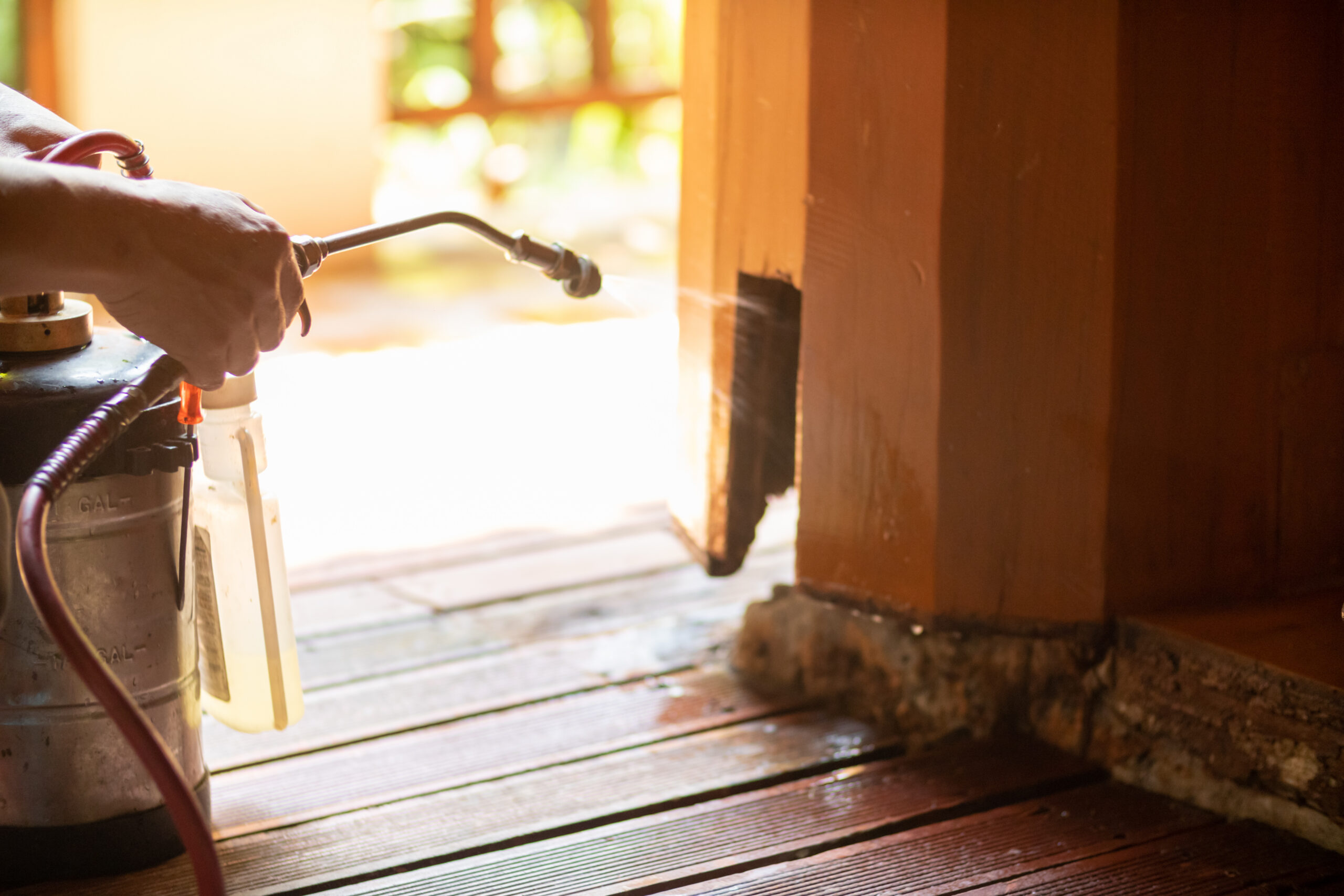
A professional spraying chemicals on wooden deck damaged by termite colonies.
I’ve owned my home for a decade. In that time, I’ve learned that the quietest issues are often the costliest. For instance, in Kansas City, once swarmers disappear in June, many assume the threat is gone. However, that’s a mistake. In reality, termites don’t leave; they just move out of sight.
Where Do Termites Go After the Swarm?
After swarming, reproductive termites drop their wings to start new colonies. Meanwhile, the worker colony stays active, eating through your home’s skeleton 24/7. These pests are poikilothermic, which means their metabolism is regulated by external heat. Although they move deeper into the soil during summer heat waves, they stay active year-round if they find the warmth of a heated foundation.
Subterranean termites are moisture-seeking insects that feed on cellulose—the organic compound in wood. To survive, they use mud tubes to travel from the soil to your structural timber without drying out. According to the University of Missouri Extension, finding large numbers of swarmers inside is a definitive sign of an established infestation.
Identifying the “Swarmer” Confusion
Homeowners often confuse flying ants with termite swarmers. Since misidentification can lead to structural failure, you should look for these morphological markers:
- The Waist: Termites have a broad, uniform waist. Conversely, ants have a “pinched” waist.
- The Antennae: Termite antennae are straight and bead-like. In contrast, ant antennae are elbowed.
- The Wings: Termites have four wings of equal length. However, ants have larger front wings.
Summer Pests: Carpenter and Sugar Ants
Carpenter ants are excavators. Actually, they don’t eat wood but bore into it to nest, leaving sawdust-like “frass.” Furthermore, as the heat dries the Kansas soil, “sugar ants” (odorous house ants) also push indoors looking for water and sweets.
How Milberger Eradicates Infestations
- Sentricon System: We install bait stations that eliminate the queen by inhibiting chitin synthesis, thereby stopping termites from molting.
- Termidor Treatment: This undetectable liquid creates a “transfer effect.” Consequently, termites share the treatment with the colony until it is wiped out.
- Strategic Monitoring: We maintain a perimeter to prevent new colonies from taking root.
Homeowner Prevention Checklist
- Clear firewood and stumps from foundations.
- Additionally, redirect downspouts to keep the soil dry.
- Seal foundation cracks to block entry points.
Frequently Asked Questions
Do termites die in winter?
No. Instead, they move deeper into the soil or stay active in heated basements and crawl spaces.
Why do crushed ants smell like rotten coconut?
That is the signature scent of odorous house ants. Therefore, they require professional baiting to stop their colony from “budding.”
Is termite damage insured?
Typically, no. Most policies consider it preventable maintenance, which makes early detection vital.
Don’t wait for the damage to become visible. In conclusion, contact Milberger Pest Control today for a professional inspection or help with other insects and bugs.